
Emotion regulation continued – in DBT therapy, attending to relationships fosters improved emotion regulation. This relates to last week’s emotion regulation core concept – building positive experiences.
The therapist talked about the two extremes – the dialectical opposites – in DBT. There’s being too open, no boundaries, and then the other end, rigid boundaries, isolationist (that’s me). I’m the only one in the group with an avoidant attachment style over an anxious one. And rigid, hard line boundaries that keep me walled off and protected. Or so I always thought.
Emotion regulation is so hard for me as it is. Feeling everything so intensely is exhausting. I’m supposed to sit with the painful emotions when they come knocking (or rather, barreling down my door and taking over my house). I’m supposed to be mindful and acknowledge them without judgment. I’m supposed to play therapist with them, with the voices screaming at me, with my already twisted mind.
This relates to relationships because it addresses boundaries and attachment together, and having people in your life is crucial for mental health. I know this cognitively. Actually putting it into practice – basically trusting people – is difficult. Almost impossible. I’m terrified of being perceived as incompetent, even crazy. I never want to be a burden, the toxic friend who is so hard to hang out with because of my shitty mental health weighing people down. Until recently, I very rarely opened up to even close friends. I only opened up to my doctors and therapists and even that was hard.
I have really tried though. When getting out of 3 South a year ago, I opened up to Ceila. I even let her visit me in the hospital, something for which I’d have been mortified before. I don’t want anyone to see me like that. But I let her. She saw me in raw form and wasn’t judgmental, only concerned. When I told her I was going to kill myself till Dr Black essentially stopped me, she was horrified.
When I got out of the mental hospital a few months ago, I let her read the journal I kept in the psych ward. It was hard to talk about out loud. I did later, at her place, when I was hearing voices and scared to be alone. She made me call the crisis line that night, and spent hours researching what to say to someone who hears voices. That was one of the nicest things anyone has ever done for me.
Besides Dr Black, I let two other people – Traci and Shelly – also read the journal. Trusting anyone, let alone a few people, with something like that, is a big deal for me. I wanted to be understood. I wanted to be heard, to say look at this crazy shit that happened to me. I’m traumatized, I need to be heard. Dr Black had challenged me over a year ago to consider being more open and less isolated for better mental health. No one can exist in isolation. I get that but it’s really hard to undo a lifetime of existing in a certain way. You almost get addicted to self abuse, to the negative self talk, to the feeling you’ll never be good enough.
So I force myself to push my boundary a little bit. I force myself to talk to people more, at least to my closest friends and there are only a few. I don’t need a lot. I’d rather have a few close friends over several acquaintances. We went to the movies last week and that is so rare for me. Crowds trigger me, large dark rooms full of people especially. I forced myself to do this. I went to dinner with Ceila last week. I’m talking more about what I’m going through, my therapy, the mental health system. I talked about the flashbacks of police and restraints and being drugged. I’m even going to host a few friends this Saturday as a sort of mini Halloween party. I’m also forcing myself to give myself a little credit. That led into the other core concept the therapist brought up – negative self talk.
I am a master at negative self talk. I have abused myself so viciously that I was driven to suicide. Coping skills were useless, but Dr Black taught me coping skills only work pre-crisis. That is a module of DBT we haven’t got to yet – distress tolerance. The therapist had us write out our most common negative self talk statements and then attempt to reframe them in a positive manner. I feel like a loser who hasn’t amounted to much in life. I’m supposed to remind myself I tried my best and did pretty well considering how hard it is to just live sometimes. I try to practice gratitude – I can live independently (for now) I have a job, I own property. I’m trying to undo a lifetime of maladaptation and toxicity.
I’ve nearly met the goal I set after getting out of the hospital. Three months’ perfect attendance at work. At first I set the lofty goal of one whole year but Ceila says start a little smaller so I don’t set myself up for disappointment. As of November 5th, I’ll have met the goal.
The therapist wants us to set small daily goals and find moments of positive experiences to further improve our mental health. She calls them “glimmers” – the opposite of a trigger. My goal is usually sleep, besides focusing on the little things that make life a little better – my morning coffee, my cat, my writing, texting with Ceila and Mike. Sending memes.
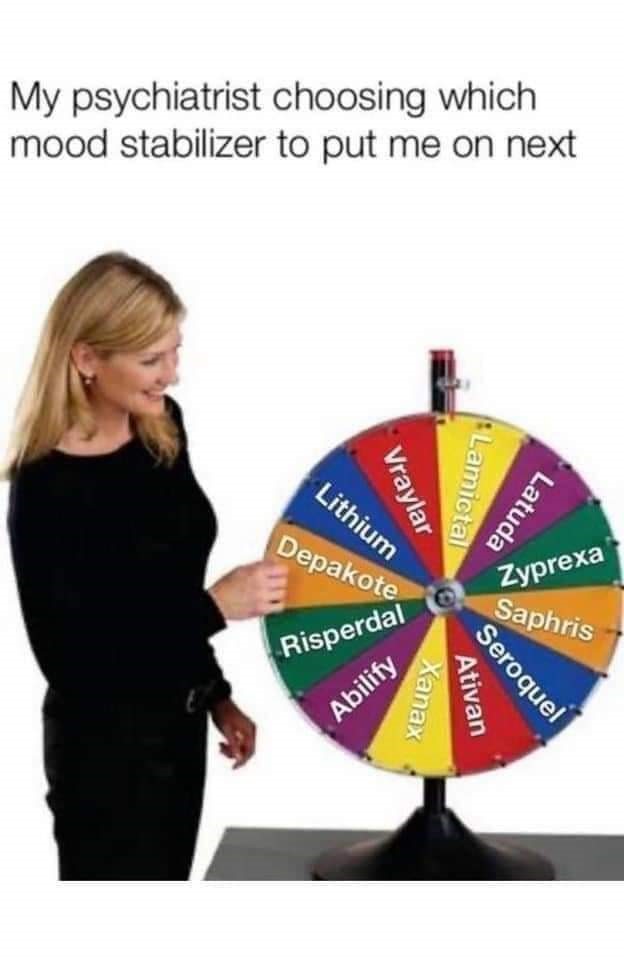

I am desperately trying here. If I don’t, I’m scared of what will happen. Dr Black tells me I very well may end up hospitalized again. She is often very honest. My “episode of care” is up in three weeks but she doesn’t want to just send me off on my own while I’m still in IOP. So after the next three weeks, I go to twice monthly for up to six months, and after that, monthly for up to a year. I will still see my medication prescriber regularly as well. Even after that year of monthly appointments, I will need to check in every three months or so, “brushing up” on all these DBT skills. Dr Black is thinking I’m one of those cases that will need lifetime monitoring and therapy to maintain what I’m trying to learn and incorporate. If I don’t do something, I’m going to die or worse, end up hospitalized forever.
 Documenting my journey through the mental health system
Leave a comment